Today in History, June 28, 1862:
Union soldiers inadvertently burn the White House. No, not that White House. In fact, the Executive Mansion which housed the President wasn’t known by that name until 1902 when President Theodore Roosevelt renamed it.
Another difference between these “White Houses”, is that George Washington never resided in the Presidential Mansion along the Potomac. His successor, John Adams was the first President to live there.
But he courted and married the widow Martha Custis at and near the White House on the Pamunkey River.
One of General Washington’s officers was Henry “Light Horse Harry” Lee. His son, Robert E. Lee, would marry Martha Custis-Washington’s granddaughter, Mary.
Together they would live in Arlington House, overlooking the Potomac…and the Executive Mansion. When the Civil War began, Robert E. Lee chose to support “his country”, Virginia; which also meant the Confederacy. As a result he and his family had to leave Arlington House and move to one of their more southern Virginia properties…the White House on the Pamunkey.
As the Union dead mounted, Union Secretary of War Edwin Stanton ordered the area around Arlington House to be used as a cemetery so that Lee could never again live there. Today it is Arlington National Cemetery.
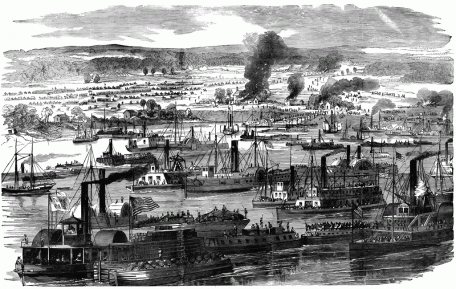
In 1862 during the Seven Day’s Battles, Union forces pushed the Confederates back past the Lee family’s new home at White House Landing, using it as a major supply base.
Before she fled further south from yet another home, Mary Lee left a message on the door of the residence, “Northern soldiers, who profess to reverence Washington, forbear to desecrate the house of his first married life, the property of his wife, now owned by her descendants.”
Union soldiers agreed. General George McClellan ordered a guard to posted around the house to prevent looting or vandalism.
McClellan took a lot of heat from the press and DC for the protection of General Washington’s one-time home. It should be used as a hospital for Union soldiers! Even though it had but six rooms.
As was frequent in the Civil War, the lines moved back north after moving south. And on this date in 1862 Confederates took White House Landing back. As the Union Army fled, McClellan ordered all supplies and outbuildings burned to prevent their use by the Confederates…with the exception of the White House, it was to be spared.
As often happens in war, orders from the top rarely get carried out to the letter. The White House was burned to the ground.

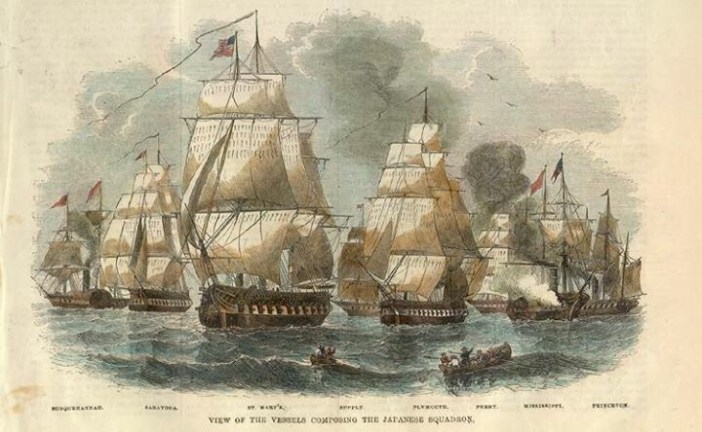 Today in History, July 8, 1853:US Navy Commodore Matthew C. Perry and his fleet arrive in Edo Harbor (Tokyo) Japan and by threat of force, demand that the Japanese contemplate relations with the US. Faced with the threat of bombardment from Perry’s ships, the Japanese accepted a letter from President Millard Filmore. When Perry returned the next year, the offer of open relations was accepted. The rest of the story is that Commodore Perry also pioneered steam power in the Navy, served under his famous older brother Oliver Hazard Perry (“We have met the enemy and they are ours!”) during the War of 1812, was a hero in the Mexican-American War, and he and his brother were direct descendents of William Wallace. Wow. The irony cannot be ignored that America dragged Japan kicking and screaming into the modern industrial world, and less than a century later would have to fight a thoroughly modern Japanese military in a world war. And then would drop an Atomic bomb on their homeland.
 Today in History, July 7, 1900:Warren Earp is killed in a bar fight in Willcox, Arizona. This is interesting for the “here’s something I didn’t know” and the “we aren’t told everything” categories. Most of us know of the exploits of Wyatt, Morgan and Virgil Earp. But how many know of Warren, the youngest brother? After Morgan was murdered and Virgil was injured in the aftermath of the “Gunfight at the O.K. Corral”, Warren, who had been visiting his parents in California, returned to Tombstone and helped Wyatt hunt down the “Cowboys” that had victimized their brothers. But, as Virgil said, “‘If Warren ever dies he will be shot. He is too hasty, quick-tempered and too ready to pick a quarrel. Besides he will not let bygones be bygones, and on that account, I expect that he will meet a violent death.” Virgil was right. On this date in 1900 Warren was bullying a local range boss, Johnny Boyett in a local bar, advancing on him and threatening him, when Boyett fired 5 rounds into him. Boyett hid out for some time, afraid of revenge from the Earp brothers. While Virgil did conduct his own investigation and decided that it was murder, Wyatt never became involved. Boyett died of natural causes in Texas, never harassed by Wyatt or Virgil.
 Today in History, July 6, 1885:9-year-old Joseph Meister had been badly mauled by a rabid dog, which meant he would almost certainly contract the horrible disease. Louis Pasteur had been experimenting on a vaccine for rabies using rabbits, and had tested the vaccine successfully on several dogs. Treating the boy put Pasteur at risk of prosecution should the treatment fail, as he was not a licensed physician. He chose to attempt to save Joseph. His vaccine was successful, saving the boy and countless others in the future. Meister would live to be 64 years old, taking his own life when the Nazis captured Paris in 1940, where he served as caretaker for the Pasteur estate.