The Cooper Union Speech

Today in History, February 27: 1860:

“One of the most happiest and most convincing political arguments ever made in this City … No man ever made such an impression on his first appeal to a New-York audience.”

— Horace Greeley in his paper regarding “The Cooper Union Speech” by Abraham Lincoln.

A former Congressman and Illinois lawyer, Lincoln had been launched to the national stage by his debates with Stephen Douglas over the slavery question 2 years before, but he was still mostly unknown in the east.

A young Republican’s group in New York invited him to speak at Cooper Union’s Great Hall. The hall was not filled for the speech, but the text of it was given to Greeley’s and other’s papers; from there it was broadly published across the nation in pamphlet form.

Lincoln made convincing arguments that the Founding Fathers were against the expansion of slavery and desired it’s eventual end. At the same time he tried to convince Southerners that the Republican party did not wish to interfere in their affairs.

While in New York he had his photo taken by Matthew Brady, and the photo was used along with the pamphlet to broaden his recognition.

It is widely believed that the speech is what launched him into the Presidency.

He closed with a message to his colleagues:

“Neither let us be slandered from our duty by false accusations against us, nor frightened from it by menaces of destruction to the Government nor of dungeons to ourselves. Let us have faith that right makes might, and in that faith, let us, to the end, dare to do our duty as we understand it.”
Where Else Would We Find Him?

Today in History, February 21, 1848:

“Where else would we find him?”

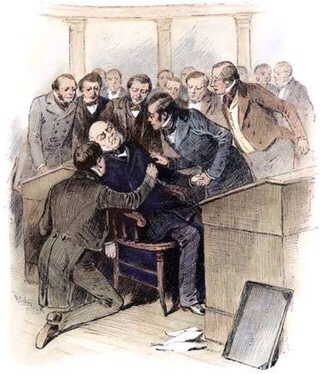
Former President, former Secretary of State, Former US Senator from Massachusetts, current Representative to the House John Quincy Adams, collapses after suffering a stroke while vehemently stating his opinion on the House floor.

Adams had, by most reports, been a mediocre President.

However he had authored the Monroe Doctrine telling European nations that America was in charge of police actions in the Western Hemisphere; he had served as the Ambassador to the Court of St. James (England); had negotiated the ceding of Florida to the US from Spain; had acted as the attorney for the slaves in the Amistad Trial; stated his vehement abolitionist views, and served 17 years in the House after his Presidency…because that’s what a servant to the people was supposed to do.

His contemporaries were not surprised that he would die while serving the people. He was carried to the office of the Speaker of the House, where he would die two days later. What an example!

Assassination Connections

Today in History, February 15: 1933 –

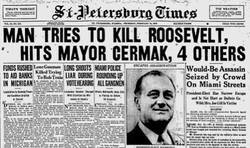
Assassination; Courage; and links between courageous Presidents. President elect Franklin Delano Roosevelt gives a speech, from his car (he is crippled, though few know it), in Bayfront Park in Miami, Florida. Standing on the running board of the car was a political ally, Chicago Mayor Anton Cermak.

Nearby a 5 foot, unemployed Italian immigrant bricklayer stands on a chair so that he can see the soon to be president, and fires his revolver. Instead of FDR he strikes Cermak before a woman standing beside him attacks him…and his next four shots injure standersby instead.

Within weeks Cermak dies…and the assassin will die by execution. Stories will go forward about whether FDR was the intended target, or Cermak, who was at the time fighting the Chicago mob.

What I find most interesting is the extended story. The crowd was about to beat the assassin to death in a bloodlust…Franklin calmed them…the suspect should face a court of law. FDR then directed that the Chicago mayor be loaded into his car, and cradled him in his lap as he was rushed to a nearby hospital. Cermak would die, the assassin would be executed…but FDR’s courage would inspire the nation.

FDR had adored his distant cousin, Theodore Roosevelt. TR had been shot in the chest while campaigning for the Presidency in Milwaukee, Wisconsin (by an insane immigrant)discouraged the crowd from abusing the would-be assassin…and continued on to finish a lengthy speech before seeking medical attention…he was a Bull Moose.

When he was a young boy in 1865 in New York, Teddy Roosevelt had watched from the window of a New York apartment as the body of his idol, President Abraham Lincoln, passed by in a funeral escort after he was assassinated in Washington, D. C. Lincoln had been discouraged from public appearances, including at Ford’s Theater, and responded to the effect that if someone wanted him dead, they would find a way. Our history is not nearly as disconnected as we think, and courage comes from knowledge and perspective.

US Weather Service

Today in History, February 9: 1870 –

President US Grant signs a joint resolution of Congress creating The US Weather Bureau. The Bureau was initially placed under the Secretary of War, in the belief that weather watch stations placed on military bases across the interior would give warning to the east coast of approaching weather fronts. The Bureau had several incarnations as it grew with technology. Today it is part NOAA, the National Oceanic and Atmospheric Administration…the Bureau has saved countless lives with it’s continued advancements in warning capabilities.

Electoral College

Today in History, January 7, 1789 –

The states first elected their Electoral College electors, who would elect George Washington as the first President. The Electoral College was established so that less populated states would not be left without a say in the choice of the Chief Executive.

If the President was elected by popular vote, the states with the highest population would always made the decision. This was of great concern to the more rural, less populated states.

The system has been tested several times throughout our history, and surely will be again.

Death had to take Roosevelt sleeping, for if he had been awake, there would have been a fight.” -Vice President Thomas Marshall

Today in History, January 6: 1919 –

“Death had to take Roosevelt sleeping, for if he had been awake, there would have been a fight.” -Vice President Thomas Marshall. President Theodore Roosevelt dies at Sagamore Hill, Oyster Bay, New York in his sleep of a heart attack. “Teddy” had taken every last drop of adventure and worthiness that he could squeeze out of life in the preceding 60 years.

Roosevelt had been a sickly child; constantly plagued by breathing problems, he could rarely play with the other children. His father, Theodore Sr., a remarkable man himself, told “Teedie” that if he wanted to have a successful life, he would have to take charge and force his body into the form he needed to match his intellect. Roosevelt did just that. He took exercise as his “raison detre” until he was barrel chested and of vigorous health. Each time he became sick during his life, he would simply work through it.

As a young man, while serving in the New York Assembly, Roosevelt’s wife and mother died on the same day…February 14, 1884. Roosevelt fled into the west, becoming a rancher and for a time a lawman in the Dakota Territory. The experience would strengthen him and give him a background people respected.

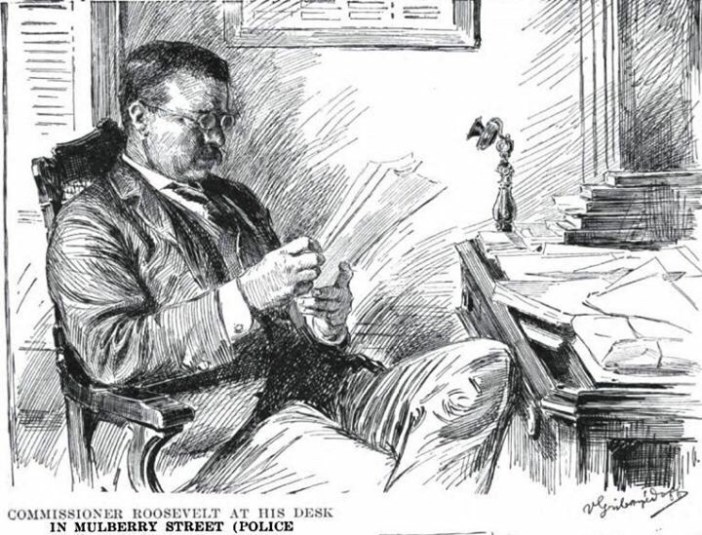
During his life he was a state rep from New York, the Police Commissioner for New York City, Governor of New York, the Assistant Secretary of the Navy (he oversaw the building of a modern US Navy while his boss was not paying attention), he led the “Rough Riders” (1st Volunteer US Cavalry) up San Juan Hill in the Spanish-American War, became Vice President, and the President after President McKinley was assassinated.

As President he defined the modern presidency, breaking up monopolies, seeing that mistreated workers got a fair shake, sent the “Great White Fleet” around the world establishing American as a world influence, saw the Panama Canal built, saw the establishment of the National Parks Service, and countless other accomplishments.

He worked tirelessly for the American people. After the Presidency he traveled extensively, going on an African Safari, and exploring an unknown region of South America, “The River of Doubt”; a region so treacherous that it was considered a no-man’s land. He nearly died in the mapping of the river, now called “Rio Roosevelt” in his honor.

All of his male children fought in WWI, and the only reason Teddy didn’t was because the Democrat President (Wilson) refused to let him, afraid Roosevelt would run against him in the next election and win. One of his sons, Quentin, would be shot down over France and be killed. That was the last straw for the “Old Lion”. He mourned dreadfully until his death.

One of his other children, Theodore Roosevelt, Jr., would be the only General to go ashore with the troops at D-Day in WWII; Teddy Jr would die of a heart attack himself several weeks after the Normandy invasion. The entire world would mourn President Roosevelt’s passing; he had become larger that life, a hero to people the world over. The quintessential American. And in case you couldn’t tell, my favorite Hero.

“If I Am Judged By My Acts…”

Today in History, December 28, 1832:

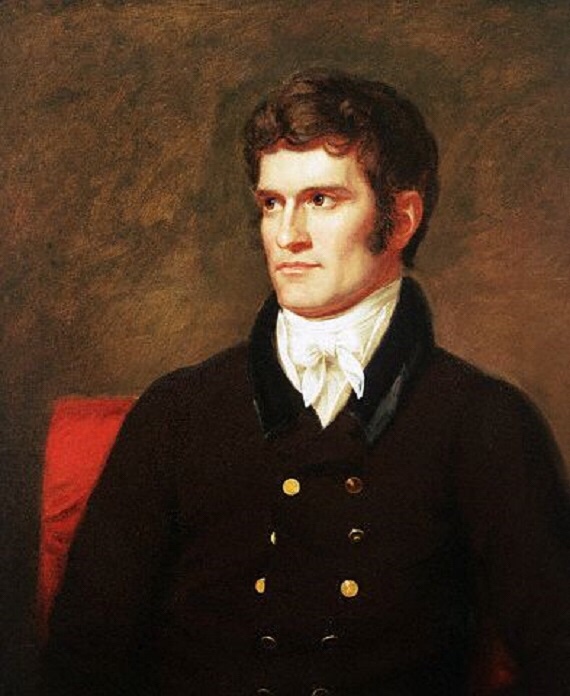
John C. Calhoun, 7th Vice President of the United States, resigns to take a Senate seat from his native South Carolina. Calhoun was a short step away from the Presidency, twice. He ran unsuccessfully in 1821, and had he been able to remain as Vice President to Andrew Jackson, he almost certainly would have been assured the nomination and perhaps the election after Jackson’s two terms had ended.

But Calhoun and Jackson would get cross-ways over accusations of adultery involving the wife of the secretary of war, along with most of Jackson’s cabinet. This and their differences over nullification (the belief that the states could nullify ANY act by the federal government-admittedly a simplified explanation, but accurate), led to Calhoun’s resignation.

Calhoun was a fierce proponent of state’s rights, and as a result, of slavery.

However, a comment shortly before his death showed his loyalties, “If I am judged by my acts, I trust I shall be found as firm a friend of the Union as any man in it. If I shall have any place in the memory of posterity it will be in consequence of my deep attachment to it.”

Calhoun felt himself a patriot. He is, perhaps, a reminder that we can disagree with someone politically without assuming they are otherwise.

A Christmas Gift

Today in History, December 22: 1864 – “I beg to present you, as a Christmas gift, the city of Savannah, with 150 heavy guns and plenty of ammunition, and also about 25,000 bales of cotton.”. General William Tecumseh Sherman wired this message to President Lincoln after his army siezed one of the few remaining port cities in the South.

The message was not merely well received. It ended a six week cliff hanger for the President and the people of the North. That was when Gen. Sherman had taken the daring move of leaving the conquered city of Atlanta, thus cutting his army off from it’s supply lines. The large army would be solely dependent upon the supplies it could obtain from the land. Everything that was not needed to feed or provision the Union Army in a huge swath between the two cities was destroyed to prevent it’s use by the South.

Sherman had several objectives: Take Savannah to prevent supplies reaching the Confederacy from overseas, join up with the Navy, and bring the horrors of war to the Southern populace in an effort to demoralize them and shorten the war.

A Pardon for “Little Sister”

Today in History, December 14: 1863 –

President Lincoln grants amnesty to his sister-in-law, Emilie Todd Helm, whose Confederate General husband had been killed at the Battle of Chickamauga. Emilie had made her way to DC and was staying in the White House with the President and her half sister, Mary Todd Lincoln. This was part of a plan Lincoln had to re-unite the Union.

By his order, any Confederate “rebel” that would swear an oath of loyalty to the Union would be granted amnesty. Lincoln hoped this would foster reconciliation and diminish the ranks of the Confederate Army.

Ironically, “four score and seven” years earlier, the British Army had pronounced the same decree, stating that any “rebel” involved in the Revolutionary War who would swear an oath of loyalty to the British Crown, would be granted amnesty; and the British decree was proffered for the same reason. In 1776 it met with limited success. In 1863, it met with some success, but the war would continue for two more years.

The Corrupt Bargain…

Today in History, December 1: 1824 –

The Presidential election had involved 4 candidates; Andrew Jackson, who by far won the most popular votes and the most Electoral College votes, but not a majority amongst the candidates. So, in accordance with the 12th Amendment, on this date the vote for President went to the House of Representatives.

The House, after much deliberation…elected John Quincy Adams President. The problem? One of the other candidates was Speaker of the House Henry Clay, who threw his support behind Adams, causing his win. Clay, “ironically”, was then appointed to the coveted position of Secretary of State under Adams. At that time in our history, becoming Secretary of State almost guaranteed you the Presidency at some point.

The Jackson Democrats claimed (probably correct) a “Corrupt Bargain”, which tainted Adams’ Presidency…minimizing any success he experienced and almost guaranteeing what happened in 1828…the landslide election of Jackson to the Presidency.