Oklahoma Proud – The Battle Off Samar

Today in History, October 25, 1944:

A desperate fight for survival, The Battle off Samar.

The Battle off Samar was only one of several major naval conflicts that constituted the Battles of Leyte Gulf. A few days previous, Gen. Douglas MacArthur had returned to the Philippines and invaded Leyte. His invasion was supported by what is likely the largest assembled fleet in history.

In the days since the invasion began, the Japanese Navy had sent 3 battle groups to intercede. One group of Battleships, cruisers and destroyers were to approach the landing forces in Leyte Gulf through Surigao Strait, another built around the massive IJN Yamato was to approach via San Bernadino Strait, and the last, built around Fleet Carriers with few planes left, was to sail far to the north and make sure they were seen, so that major US forces defending the thin skinned landing ships would leave them unprotected.

The Japanese fleet approaching through Surigao Strait was decimated by American Battleships raised from the mud of Pearl Harbor in the last Battleship vs Battleship engagement in history (US Cruisers and Destroyers were key also).

Admiral Kurita’s force around Yamato was bombed on the 24th and turned back.

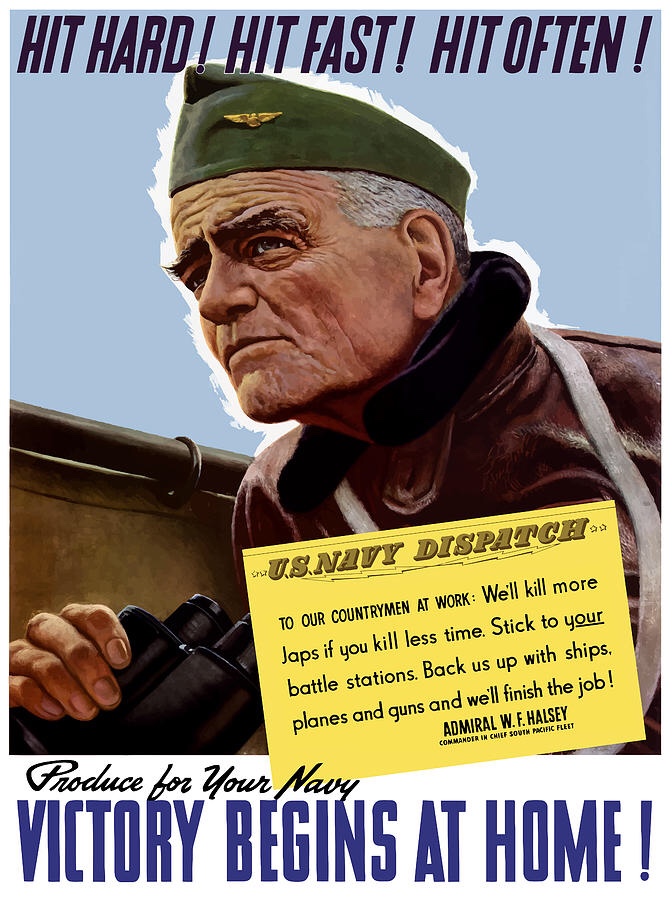
Admiral William F. Halsey, known to Americans and Japanese for his aggressive nature (By the time we’re done, the Japanese language will be spoken only in hell) commanded the US 3rd fleet…4 battle groups of 4 fast carriers each, and another of fast battleships.

He took the bait, going after the Japanese carriers that were actually playing no combative part in the battle.

This left only cargo ships, small combatants, and “Jeep Carriers”, or Escort Carriers…basically cargo ships with a flight deck built atop their small, thin hulls. The escort carriers were tasked with close support for troops ashore, and were not equipped for a sea battle.

So far, I’ve just set the stage for the events of the Battle off Samar Island…now for the good part. There were 3 small escort carrier task forces left in Leyte Gulf…Taffy 1, Taffy 2 and Taffy 3. As they began operations on the morning of the 25th, Admiral Clifton “Ziggy” Sprague and the men of Taffy 3 were shocked to find that IJN Admiral Kurita’s task force of fast battleships, cruisers and destroyers, who had turned around in the night, bearing down on them. I recently finished “Last Stand of the Tincan Sailors” by James Hornfischer, and although I knew about this battle, I found out much more, and Oklahoma connections.

The entirety of Taffy 3…6 jeep carriers, 2 Fletcher class destroyers and 3 destroyer escorts…did not match the tonnage of the Yamato alone. And Yamato was joined by several other Battleships, Cruisers and destroyer task forces. The Japanese could manage much more speed than the small American ships, and their guns (18 inch for the Yamato, 14 and 8 inch for the others, out-ranged the American’s 5 inch guns by MILES. As the long range rifles (22 miles avg) began dropping shells around the carriers and destroyers, Admiral Sprague ordered the small destroyers and destroyer escorts to lay smoke and attempt to delay the inevitable. Oklahoman Harold Kite, loading a 5 inch gun on the stern of the carrier USS Fanshaw Bay, watched the tiny escort ships turning to race towards the huge enemy ships, and likened them to the horses that had raced across the plains of central Oklahoma as he was growing up, and marveled at their courage.

The closest escort ship to the Japanese fleet, the USS Johnston, was commanded by another Oklahoman…Commander Ernest E. Evans, known to his Annapolis classmates as “Chief” for his Cherokee heritage. His crew knew what they were in for. Cmdr. Evans had been there for the American defeat during the Guadalcanal campaign, and took his warrior heritage seriously.

When he took command of the Johnston, he told her crew, “This is going to be a fighting ship. I intend to go in harm’s way, and anyone who doesn’t want to go along had better get off right now. Now that I have command of a fighting ship, I will never retreat from an enemy force.”

And he didn’t. Under the fire of longer range, larger guns and other fast destroyers, he raced in close, ordering his gun crews to fire constantly, which they did with amazing effect, and launched his small ship’s torpedoes against the enemy, achieving strikes that disabled cruisers. Fighting to the end, Evans was looking after the survivors of his sinking ship when a Japanese shell destroyed the part of the superstructure he was in, and he went down with his ship.

The other American destroyers and destroyer escorts (even smaller) followed suit, delaying the Japanese ships and confusing them to the point that the Japanese thought they were actually fighting American cruisers and fast carriers…heavies in Navy parlance.

The Jeep carrier’s aircrews were launched in desperation as the battle began…armed with whatever they had…depth charges, anti-personnel bombs, but nothing that was designed to sink ships. The aircrews, flying torpedo bombers, dive bombers and fighter planes, attacked the Japanese ships with desperate ferocity. They dropped the depth charges as best they could beneath enemy ships, dropped their bombs, then came back and made runs against the enemy ships without arms because it would mean the IJN ships had to evade (and slow down) since they didn’t know there were no torpedoes or bombs on the American aircraft. One pilot, out of ammunition, flew alongside a Japanese heavy, opened his canopy, and emptied his .38 revolver into the ship’s bridge to the amazement of her crew.

The flyers then flew to a land base on Leyte and re-armed to attack again. In the end, Admiral Kurita, believing he was attacking a much larger force, ordered his massive force to turn about and retreat.

As for Halsey, who couldn’t leave even his Battleships, or even 4 of his 16 Carriers to defend the Taffy’s and the all but defenseless cargo ships in Leyte Gulf….he received a dispatch from his boss, Admiral Chester W. Nimitz, asking, “Where is Task Force 34? All the world wonders.” The story is that “all the world wonders” was just jibberish added to transmissions to confuse the enemy…but the result was an angry Halsey throwing his cap to the deck and spewing a string of invectives. Of the destroyers, including the Johnston and the Samuel B. Roberts that went down in the battle? Amazingly, many of their crew were lost to sharks before they were rescued in the days hence, the result of faulty reports of their locations. So many brave heroes.
Halsey Takes Command – Its All About Attitude

Today in History, October 18, 1942:

Vice Admiral William “Bull” Halsey is named commander of the South Pacific forces.

Things had not been going well after the invasion of Guadalcanal; a series of losses due to indecision by the previous commander, Admiral Ghormley, had left the troops demoralized.

CINCPAC (Commander in Chief, Pacific) Chester Nimitz knew the man for the job and appointed Halsey. Halsey was a no nonsense, get er done leader.

He had issued orders to his task force to shoot first and ask questions later if they spotted Japanese ships or aircraft…on November 28, 1941, ten days before the Japanese attack at Pearl Harbor.

He was famously quoted as saying, “Before we’re done with ’em, the Japanese language will be spoken only in hell.” His operational order for his command was simple: “Kill Japs, Kill Japs, Kill more Japs!” In retrospect, this attitude made be considered harsh or even racist. But during the largest conflict in human history, it was all about winning.

The demoralized Sailors and Marines serving on and around Guadalcanal had a sudden burst of confidence when they heard Halsey was their new boss. Things turned around almost immediately. The people under Halsey’s command knew he was willing to take chances for them, and they returned the sentiment.

The Mighty Eighth

Today in History, October 14, 1943:

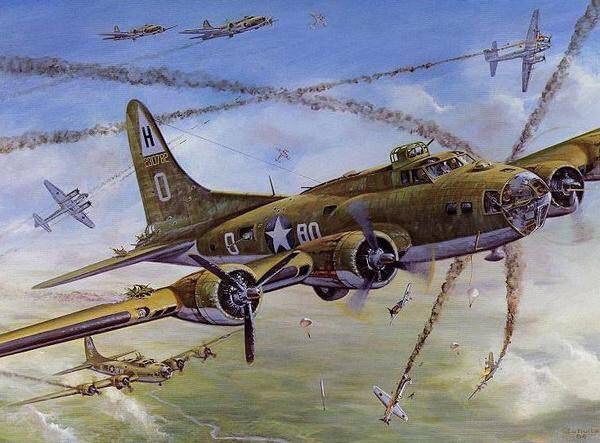
During it’s Second Raid on Schweinfurt, Germany’s ball bearing plants, the Mighty US Eighth Air Force loses SIXTY B-17 Flying Fortress bombers to German fighters and anti-aircraft fire.

That number becomes more ominous when you know that each aircraft had at least a 10 man crew, meaning that 600 airmen either lost their lives or were captured that day. Many don’t realize that the casualties of the Eighth Air Force over Europe accounted for more than half of the losses for the entire US Army Air Corps, and at over 26,000 dead, surpassed the horrific losses of the US Marine Corps during the war by far…the USMC having lost almost 18,000 dead in the bitter battles in Pacific Islands.

Iron Bottom Sound Receives Its First Occupants

Today in History, August 9: 1942 – Two days after the US Marines had made an amphibious landing on Guadalcanal seized what would become Henderson Field, the transports that brought them still stood off the coast, protected by 8 American and Australian Cruisers and 14 destroyers. In the early morning hours a force of Japanese Heavy and Light Cruisers moved silently into the waters between Guadalcanal and Savo Island and opened fire on the American and Australian warships, which they caught, quite literally, napping. The British commander of the Allied force, Admiral Crutchley had taken his flagship to a conference with the amphibious force commander, Admiral Richmond Kelly Turner and Marine Gen. Alexander Vandergrift, leaving a subordinate in command. The Japanese Navy had been practicing and perfecting night time combat tactics for years, a fact the USN was not aware of, so they weren’t really expecting an assault. The Japanese also had very effective torpedoes. Several of the Allied ships managed to get off some shots that caused minor damage to the IJN cruisers, but the experienced, practiced Japanese crews poured withering torpedo and gunfire into the American and Australian ships, whose crews were exhausted from 2 days of shelling the enemy ashore in humid high temperatures.

Within an hour the USS Astoria, USS Quincy and USS Vincennes were on their way to the sea floor, making the first of many deposits that would give this passage the name “Iron Bottom Sound” because of all of the Allied and Japanese ships that now rest there with their crews. The next day, Admiral Turner would order the HMAS Canberra scuttled due to her damage. The US aircraft carriers that had been providing air cover for the landings had been ordered out of the area by their commander, Adm. Frank “Black Jack” Fletcher. The transports and their covering surface ships could not remain with range of Japanese aircraft without air cover of their own, so they too left the area, leaving the Marines to their own devices for quite some time. Numerous battles would be fought in the waters of Guadalcanal, Savo and Tulagi Islands, and in “The Slot” leading from Guadalcanal to the enemy bases in the Solomons.

PT-109

Today in History, August 1-2, 1943:

PT-109 (Patrol Torpedo) is patrolling Blackett Strait in the Solomon Islands when it is rammed and cut in half by Japanese Destroyer Amagiri.

Two of the crew are killed outright, but 11 others survive, although some are badly injured/burned. Their very young commander carried one of the injured on his back in the mile + swim to a nearby island. He then took turns with the boat’s exec swimming back out into the channel attempting to signal other PT’s at night while avoiding Japanese patrols.

Finally they were rescued thanks to natives working for an Australian coast watcher. Lt. John Fitzgerald Kennedy, who could have easily sat out the war due to his wealth, displayed incredible courage and loyalty to his crew.

One question not asked in the propaganda of his Presidential campaign was, how does a craft that is basically a speedboat, navigated by an experienced sailor, get rammed by a slow moving man-of-war? That aside, nobody can deny President Kennedy’s courage.

“Operation Drumbeat”

Today in History, July 19, 1942:

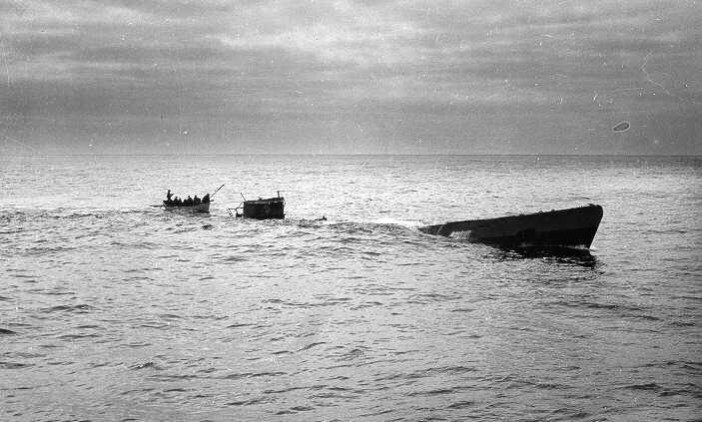
Admiral Karl Donitz is forced to call off “Operation Drumbeat”, recalling Nazi U-Boats assigned to the American coast.

In the months after America’s entry into the war, there were no convoys along the coast and coastal cities did not engage in “black outs”. This meant merchentmen sailing the American coastline were sillouetted by city lights, making them easy targets.

Donitz ordered the long range submarines he had at hand to attack merchant shipping along the coast, and they sank 297 merchantmen by June.

The Americans finally got a convoy system in place, utilizing destroyers and patrol craft. As it became increasingly difficult for U-Boats to prey on US merchants, and as the patrol craft began taking the fight to the Nazis, Donitz called his subs off, sending them back to the North and Mid-Atlantic.

Quentin Roosevelt

Today in History, July 14, 1919:

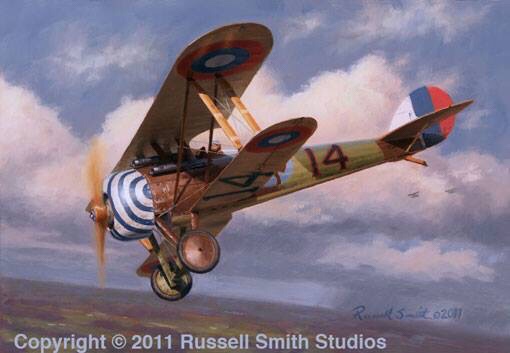
US Airman Quentin Roosevelt, youngest son of President Theodore Roosevelt, dies when he is shot down over France in WWI.

He and his brothers, who all served in WWI were very competitive in the voracity of their service, trying to live up to their father’s exploits…a father who also wanted to serve but was refused due to President Wilson’s fear that TR’s service might lead to a run for President in 1920. TR wouldn’t live that long…and he spent his last years heartbroken over the loss of his youngest son.

TR Jr. would die of a heart attack just weeks after leading his division in the Normandy invasion of 1944…again living up to his father’s legacy. A family of immense wealth; several generations of which dedicated their lives to service to their country.

Consequences of Propaganda

Today in History, July 9, 1944:

Victory at the Battle of Saipan. The US Marines defeat the Japanese military on Saipan, the first island with Japanese civilians to be taken by the US.

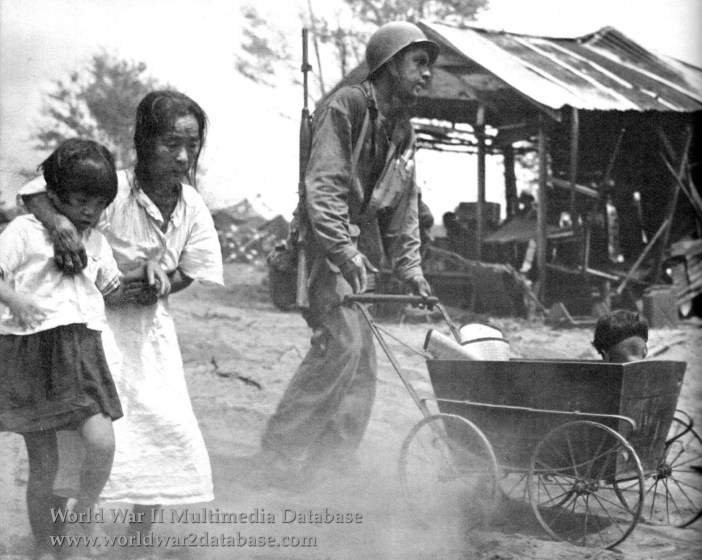
It was a difficult battle, made all the more so by the existence of a civilian population. The Marines set up well lit camps for the civilians to be safe from battle.

Fearing that his citizens would find out that the Americans were not the vicious, heartless enemy projected by propaganda, the Emperor issued a communique to the civilian population of Saipan, telling them that if they committed suicide they would receive the same treatment in the afterlife as Japanese soldiers that died in battle.

American servicemen were horrified as Japanese civilians threw their children from cliffs, then followed them to the rocks below. The newly won island would be used as an air base for B-29 Superfortress bombers that would bomb the Japanese mainland.

Rabies Vaccine

Today in History, July 6, 1885:9-year-old Joseph Meister had been badly mauled by a rabid dog, which meant he would almost certainly contract the horrible disease. Louis Pasteur had been experimenting on a vaccine for rabies using rabbits, and had tested the vaccine successfully on several dogs. Treating the boy put Pasteur at risk of prosecution should the treatment fail, as he was not a licensed physician. He chose to attempt to save Joseph. His vaccine was successful, saving the boy and countless others in the future. Meister would live to be 64 years old, taking his own life when the Nazis captured Paris in 1940, where he served as caretaker for the Pasteur estate.

The Great Marianas Turkey Shoot

Today in History, June 19, 1944:

Reversal of Fortunes, exhibited by “The Great Marianas Turkey Shoot”, or the First Battle of the Philippine Sea.

US Marines, supported by their parent service, the US Navy, are invading Saipan and other islands in the Marianas Islands, which is such a threat to Japan that the Imperial Japanese Navy finally comes out to fight a definitive battle.

When the war began the Japanese had the most advanced aircraft available, while the US Navy lagged sorely behind. The Japanese Zero, for example, was much faster and more maneuverable than the American Wildcat fighter. But by 1944 the American industrial complex had engaged fully. As late as 1943 the USS Enterprise stood alone in the Pacific against numerous IJN Carriers.

But by June of 1944 the Americans put to sea 15 Aircraft Carriers in 4 Task Groups equipped with modern aircraft that far out matched Japan’s aircraft, which had not been updated since the war began. In addition, Japan’s air service had lost nearly all of it’s experienced pilots, while the Americans had thousands of combat hardened, well-trained pilots and crews.

When the IJN sent it’s carriers and their crews against TF 58, they were massacred. In two days the Japanese lost over 400 aircraft and their crews, 3 aircraft carriers they could not spare, and the Americans lost 29 aircraft (some of the crews were rescued) and no ships. So many Japanese aircraft fell from the skies that a Lexington pilot referred to it as an old time turkey shoot, and the name stuck.

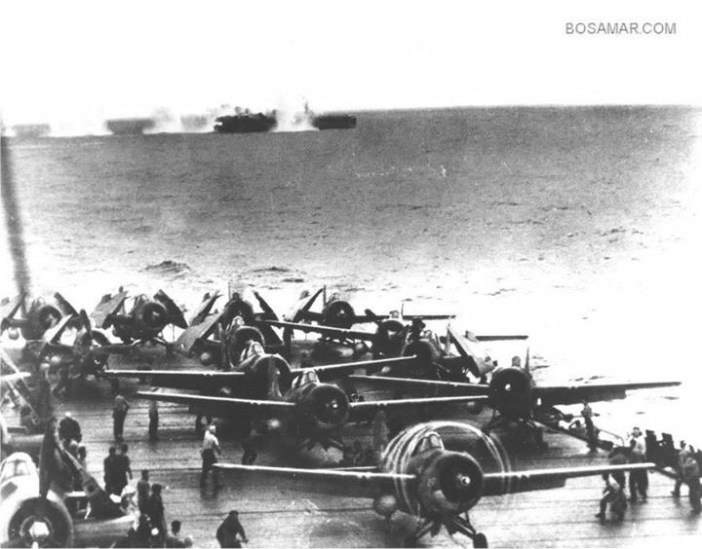
The air crews of the task force had been launched late in the day on the 20th to attack the Japanese fleet. When they returned, it was well after dark and they began landing their planes in the sea, unable to see the carriers well enough for landings aboard.

With the threat from enemy submarines and aircraft during the war, blackout conditions were the rule. Admiral Marc Mitscher wasn’t going to lose his boys and their planes, however. With his order the fleet lit up, and the planes began landing on fumes.